
Wuthering Whites
BookTok, lolcows, Humiliation Ritual, and the Lovers of the New Gothic

“We don’t take kindly to foreigners here,” Nelly cautions Lockwood in Emily Bronte’s 1847 novel. Wuthering Heights displays a similar resistance to the intruder it’s found in director Emerald Fennell’s 2026 adaptation. Wuthering Heights is notoriously challenging to adapt, perhaps because it is a story which demands to be told in its entirety. As with Lockwood’s prompting of Nelly in the novel’s narrative frame, its story resists any attempted allision, any collapse of its nuances. One might argue that it is the task of adaptation to translate, rather than to mirror– to interpret, rather than to exact. However, Fennell has miscommunicated the essential language of the text from which her adaptation is drawn; her translation suffers the lack.
Fennell has called Wuthering Heights too “dense, complicated, and difficult,” to faithfully adapt (People). She has attempted it, however, in what can only be described as big-budget fanfiction; Fennell’s thirty five year old teenage Cathy (with visible filler ) appears as a self-insert, her whitewashed Heathcliff, a gold-toothed Byronic hero.
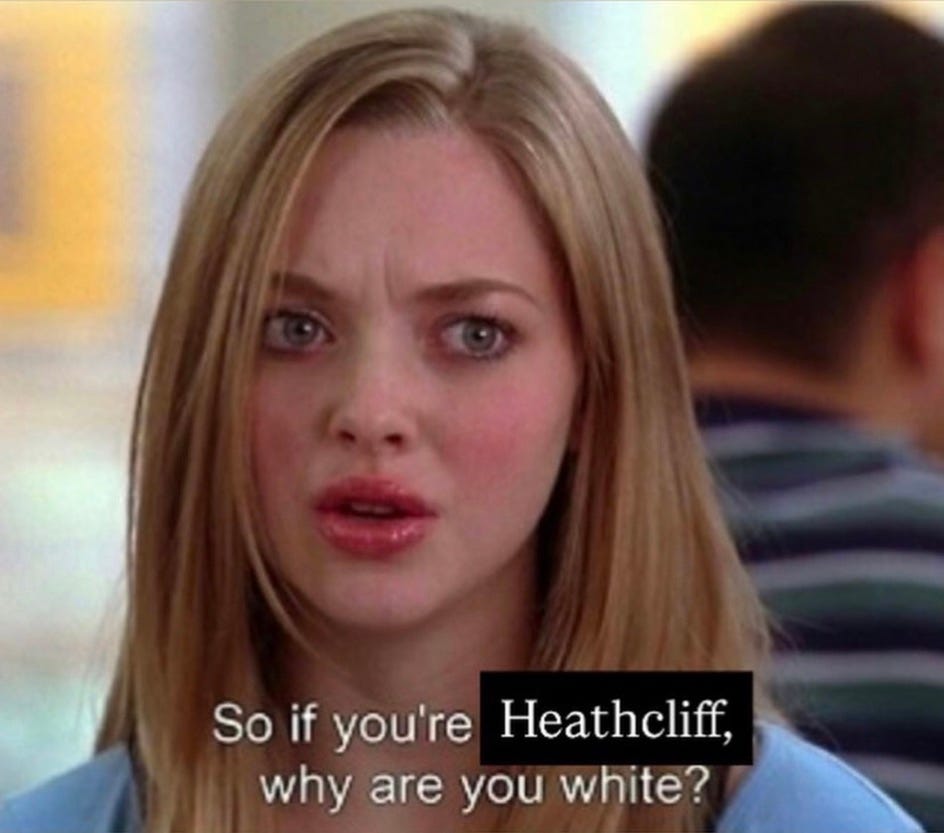
When Fennell does manage to strike a chord that rings true to Wuthering Heights, even fleetingly, the moment sings. When Cathy torments Isabella as Heathcliff looks on, grinning, taking pleasure in her jealousy and her cruelty, for instance. The child to whom the audience is introduced in the film’s first act, is unmistakably Cathy. Her cruelty, her possessiveness, her pride, and her final words to her father (borrowed from the novel) are precisely the mischievous, half-feral child lovers of Wuthering Heights will instantly recognize.
The film opens on a lynching (of a white man) whose sounds, in the darkness of those first seconds, might be those of sex, forecasting the libido– the id–at the heart of Wuthering Heights. It is the most interesting scene in the entire film. The presence of the hung man (in a double sense), tonally establishes the tantalization and brutality which shape both Cathy and Heathcliff, and which characterize the novel.
The Gothic novel, categorically, contends with structures of inequality, oppression, and with a changing world. I suspect that this is the reason for its resurgence in modern pop culture; we are living in a time of rapid economic turbulence, political instability, and technological revolution akin to the time in which Bronte herself wrote.
It is the language of oppression which is employed in the dynamic between Heathcliff and Hindley (the latter of which is omitted from Fennell’s adaptation altogether). It is oppression which drives Heathcliff to the extremities of hatred. It is race and class which divide Cathy and Heathcliff’s fated union. It is race and class which engender and perpetuate hatred between all of the characters who feel it– Nelly, who feels even her meager place within the hierarchy threatened; Hindley, whose introduction to Heathcliff employs the language of usurpation. The threat is such that even Cathy spits in Heathcliff’s face on first meeting.
Cathy is as wild as the moors themselves, as much a changeling as Heathcliff. When she delivers the line I had inscribed on my husband’s wedding band, “whatever souls are made of, his and mine are the same,” the gut punch lands because the reader has seen her proclamation thoroughly demonstrated.
In Fennell’s film, the line with which I opened my wedding vows carries the awkward feel of a plagiarized paragraph in a high school essay (I should know). Dialogue from the novel itself, rare as it is in Fennell’s telling, feels more foreign than Bronte’s Heathcliff after the first act. Bronte’s novel, like Heathcliff, is oppressed in Fennell’s telling in favor of simpler, more comfortable fare. The result is a timid gesture toward transgression without the artistic integrity to engage with its source material.
The defanging of Fennell’s Heathcliff’s is perhaps necessitated by the removal of nearly every circumstance which, by Nelly’s admission, “could make a fiend of a saint,” or perhaps is simply in service of creating a more palatable leading man. Fennell’s Heathcliff is the yaasified shell of a captivating, complex, and tragic figure. Having all the chemistry of two actors in any low budget porno (with a scooped out plot to match), Cathy and Heathcliff’s love– a love which is possessive, consumptive, brutal, even monstrous– fails to translate. The result is best described as pornslop or, more generously, AO3 fare. Heathcliff, for Fennell, is an ornament to be used and discarded; effectively a fucktoy. This treatment feels somehow uglier than her casting, though I suspect that the two impulses were not entirely separate.
The failings of this adaptation are no fault of either Jacob Elordi or Margot Robbie who, while miscast, deliver strong performances. Unfortunately, the tenor of the project as a whole detracts from their dynamic which seems, like the haunted manor, to pull at its own shutters, demanding like Cathy’s ghost to be let in. That is to say, Emily Bronte’s Wuthering Heights haunts Fennell’s tenancy within its halls. Fennell appears to the audience as Lockwood– an interloper, not an authority.
Here, I suspect, is where the adaptation draws ire. It’s certainly where it has drawn mine. Wuthering Heights, as proven by the failure of this adaptation, does not translate as modern BookTok slop for the anti-intellectual age. Heathcliff cannot be book-boyfriend-ified. He is not Rhysand, or Xaden, or [insert names bored housewives-turned-authors have Chat-GPT’d up for their own pseudo-Edward Cullens]. Heathcliff is not, as Fennell would have us imagine, a “consent king.”
Heathcliff is the product of hate which begets hate. He is the twist of the knife, the bloody jaws of the dog at Cathy’s ankle. He loves Cathy deeply, but that love’s putrefaction into something twisted, hollow, and cruel is not a mere feature of his character– it is his character. His hate and his grief have eaten away at Heathcliff until, by the time the reader encounters him, there is nothing else left.
In the novel, he is described as, “a gypsy in aspect,” and, “dark skinned.” Nelly posits, “Who knows, but your father was Emperor of China, and your mother an Indian queen.” He arrives at Wuthering Heights speaking a foreign language, understanding no English. Heathcliff’s exact origin is unknown, but it is clear that his otherness is the primary motivation for the torture he endures.
The singular way Fennell seems equipped to contend with the structures of domination and oppression is through… pet play. On first meeting, it is Cathy, not Earnshaw, who christens Heathcliff. She takes him, not as a companion, but as a pet. In Heathcliff’s enacting a sexual iteration of this dynamic over Isabella, the twist of Heathcliff’s love is legible, though his repeatedly asking for her consent to use her as a pawn in his greater game with Cathy renders the brutality characteristic of his behavior within their marriage flaccid. Notably, in the novel, it is implied that Isabella’s conception of Heathcliff’s son was less than consensual, which is likely why Isabella’s puppy play arc in Fennell’s adaptation has rubbed some viewers the wrong way. Her lolcowization layers insult onto the injury of her heartbreak and abuse at Heathcliff’s hands.
On the question of whether Wuthering Heights is a feminist text, Fennell said to W Magazine, “Yeah, oh my goodness.I don’t know that any transcendent art made by a woman couldn’t be feminist,” revealing the extent of Fennell’s consideration of the issues raised in her work: I (a woman) made it, therefore it’s feminist. Unfortunately, queen, that’s not how it works!
I contest that Wuthering Heights is not feminist in a modern sense; one could call it feminist that Emily Bronte published a novel at all in 1847, but that seems lazy in this context. The humiliation to which Fennell subjects Isabella (for example), despite her consent, is not feminist, in that liberation is not the same as satisfaction, much less sexual gratification. Isabella’s leaving Heathcliff at great personal cost, on the other hand, might be considered so, but I digress. It’s okay that feminism is not the project here—it needn’t be— but Fennell’s insistence upon its being so lends credence to every complaint about white women’ s patterns of deflection ever iterated in an Instagram infographic.
The fuckboyification of Heathcliff, utilizing Jacob Elordi’s uncanny ability to affect a flat-eyed stare, works well within the context of the adaptation, but nonetheless nettles similarly. I have often joked that I’m unofficially running Elordi’s Oscar campaign for how ardently I’ve praised his performance (in the role of my favorite fictional character of all time) in Del Toro’s Frankenstein. Elordi’s wide, sad eyes which deaden before us onscreen in Wuthering Heights, chillingly memorable to those who loved him in Euphoria, is enough to render him a passable Heathcliff.
Elordi is not the first white Heathcliff, and while I hope that he will be the last, I suspect otherwise. However, his casting (and Linton’s) as representative of Fennell’s fantasy (by her own admission) reveals something deeply ugly in Fennell’s, perhaps unconscious, perceptions of desirability and race. Fennell has spoken of her fourteen year-old attachment to the novel, her desire to render that precise imagining onscreen, but she has also acknowledged adapting Wuthering Heights as “a huge responsibility” (BBC). Unfortunately for her film, she seems to have shirked that responsibility entirely.
Fennell has defended her casting of Elordi as reflective of how she initially pictured Heathcliff. One assumes the same may be said of Linton. Edgar and Heathcliff are romantic foils–one light, the other dark, in aspect and in nature. The swap committed by Fennell implies a certain casual racism. In her imagination, it is the effete brown man whom Cathy uses essentially as social leverage, while yearning for the strapping (white) Heathcliff.
Color blind casting simply does not work for stories which deal as heavily and fundamentally with race as Wuthering Heights. Even if one attempts to make the argument for Heathcliff as Black Irish (yawn), the role Heathcliff’s otherness plays in his subjugation is so evident that its omission effectively completes the task of neutering his character. In it, Fennell subjects Heathcliff further as a doll to be played with, to manipulate as she pleases. Here, Fennell’s treatment of Heathcliff the character mirrors Cathy’s, without Cathy’s soul-deep love to offer it redemption.
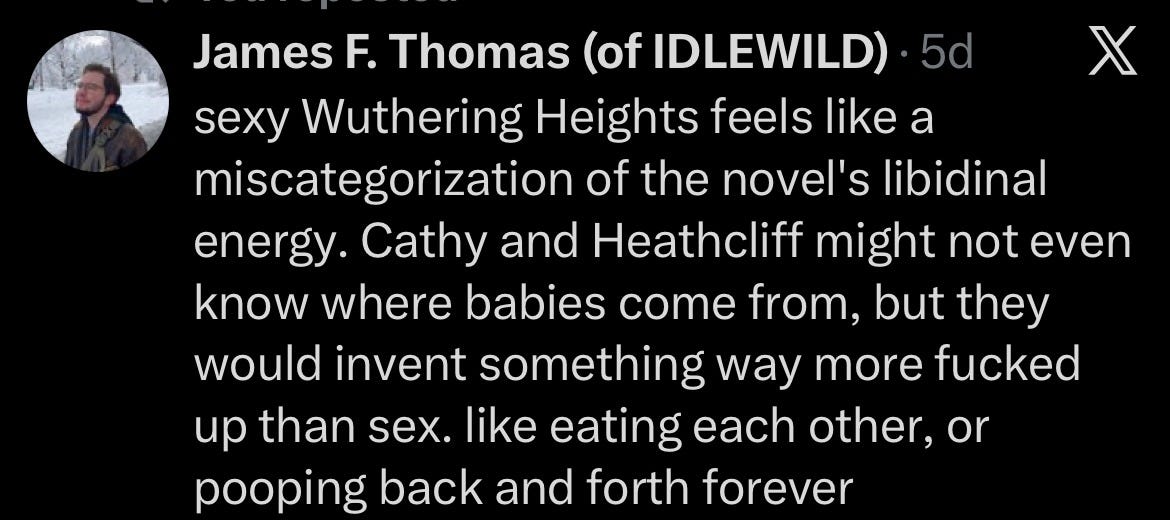
What Fennell seems only to brush the surface of in contending with Wuthering Heights is the libidinal impulse which anchors the dynamic between Heathcliff and Cathy– it’s not just sexual, it’s something darker; it is masochistic in a way which exists outside the realm of kink altogether. It’s weirder. It’s worse. As Idlewild author James F. Thomas put it, “Cathy and Heathcliff…would invent something way more fucked up than sex. Like eating each other, or pooping back and forth forever.”
In a wasteland of blue light, blue screens, the cold blue of a sent message, it is not surprising that readers, viewers, and auteurs alike gravitate toward the burn of a love hotter than the fires of hell itself. The allure of the Gothic lover is the allure of yielding to one’s passions; yielding to the man one should not love but who haunts one’s dreams. Giving in, coming undone. All-consuming desire offers a balm to our nonplussed, nonchalant, idgaf-war-torn romantic hellscape.
In many ways, Edgar Linton represents the best-case scenario, both for Catherine and for a modern woman. When I first read Wuthering Heights, I was twenty three years old and engaged to my own Edgar Linton. He was kind, mild, and easy to get along with; but I knew all the while that something fundamental was missing.
When Cathy lamented, “Whatever souls are made of, his and mine are the same,” I squirmed as he sat beside me in the driver’s seat of my Honda Fit. Like Cathy, I dug my heels in, determined to see my commitment through. This is the brand of settling which goes politely unmentioned, particularly to oneself. As with Cathy, my obstacle was “in whichever place the soul lives–in my soul and in my heart.” Like Fennell, my connection to the novel is highly personal. It is perhaps for this reason that I, like so many others, was so disappointed by this adaptation.
Still, I want to be careful not to participate in the kind of criticism which reads effectively as “I wish this work had been another work entirely,” which is to say, I want to evaluate it on its own terms. However, I find that regardless of the intention Fennell claims, one cannot escape the source material if one chooses to adopt the source material. It is there, scratching at the window.
If Fennell wished to present a fourteen year old’s dreamlike impressions of a novel as she has expressed across several interviews, or a sexual fantasy of a book character (I question the choice of Heathcliff, but– me too, girl), or a “fever dream,” this might have been accomplished, particularly through Fennell’s favored use of montage. However, even here, I find that the adaptation falls short of what it portends.
Fennell’s Wuthering Heights feels like a “fever dream,” in only the laziest of ways; a kaleidoscope of the most outlandish things money can buy (skin room anyone?), culminating in a literal fancam. What feels offensive about the flattening of Wuthering Heights under the guise of Fennell’s adaptation as one, “for the freaks,” is that the source material makes Fennell’s adaptation look like– well, Barbie.
The whole film has the feel of a girl playing dolls, no less so because of Isabella Linton’s dollhouse motif. However, the girl playing dolls is not Cathy, who might rip out their hair, fashion it into a noose, and leave them in horrifying dioramas for the other inhabitants of the manor (Joseph) to find. Instead, it is Fennell, an Isabella Linton in her own right, fantasizing about finding a wet Jacob Elordi in her bedroom, or looking as pretty as Margot Robbie in a 2016-esque holographic saran wrap prom dress…for some reason.
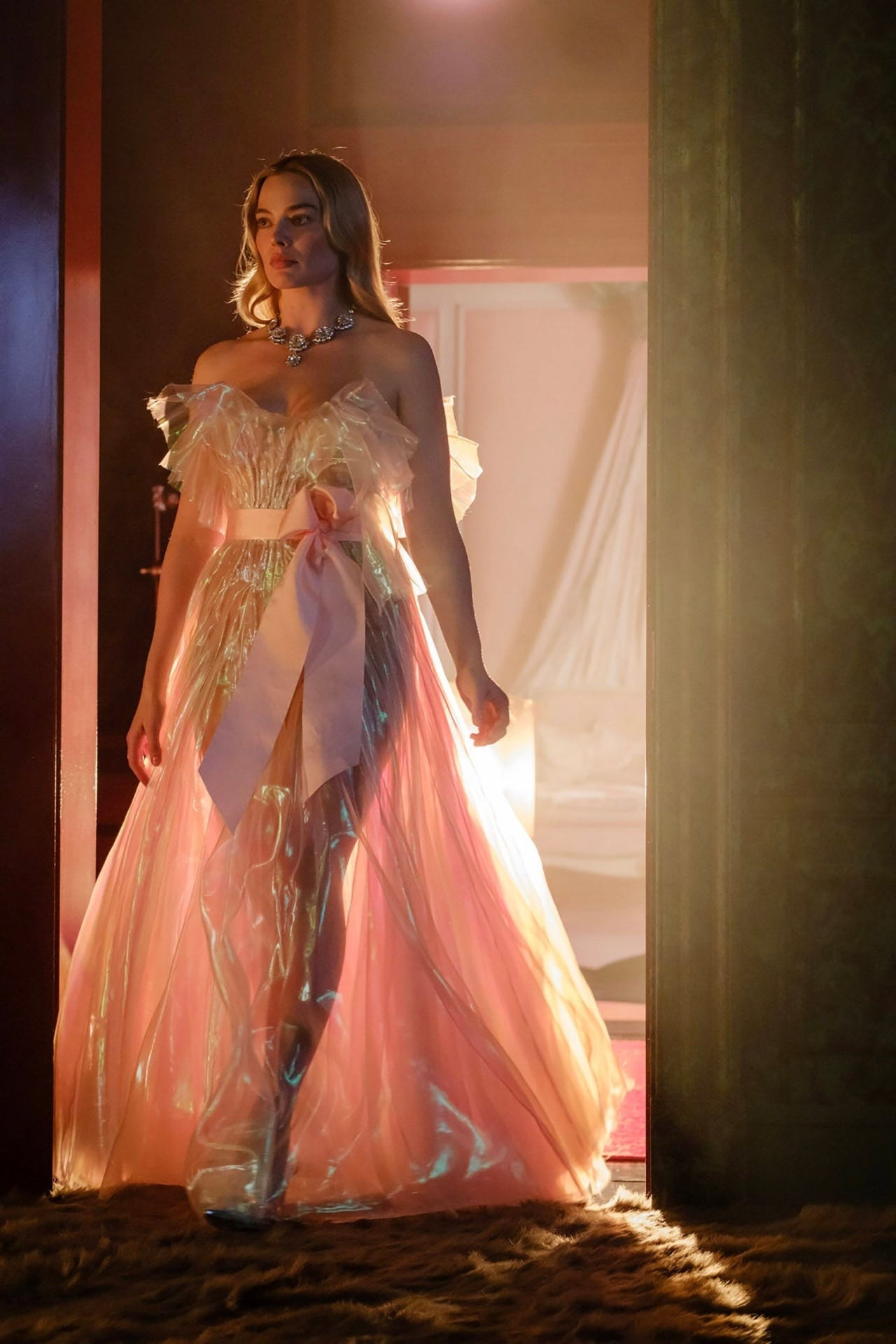
While I’m all for anachronism and artistic liberty, the lack of any coherent (much less cohesive) visual language read not as avant garde, but as sloppy and unfocused. It occurred to me that the style of dress Cathy adopts as she grows closer to the Lintons may have been intended to communicate the ridiculousness Heathcliff would have interpreted in it. However ultimately, Fennell’s film does not leave one with the impression that any credence was given to its visual language beyond achieving a palatable outlandishness which feels vapid rather than exciting, or even interesting. The fourteen year old having this particular fantasy simply does not appear to have done her homework.
From Ian Youngs’ 2025 BBC Culture report
I thought, Oh, you can go there. You can make something really disturbing and sexy and nightmarish,” Fennell says. “[Wuthering Heights] just got me in its grip.”
It surprised me, when watching the film, that Fennell does not “go there,” nor does she go much of anywhere. I find transgression for its own sake rings hollow; transgression- shock value– for its own sake, lacks artistry. If Fennell has attempted to make a transgressive piece of art, she has failed. Transgression must be in opposition to some sort of establishment in order to be meaningful– to push boundaries, boundaries must be defined and enforced in order to justify rebellion.
Fennell appears to labor under the delusion that transgression is the same as shock, forgoing the element of boundary, rebellion, or establishment– perhaps because (on a professional level) she is a stranger to boundaries, because she is a product of the establishment– because against what could a girl born with a silver spoon in her mouth possibly rebel?
I am not generally interested in the question of who has the “right” to tell what story, but after watching this film I dare to venture that one whose 18th birthday party was covered by a Condé Nast magazine may not be best equipped to engage with the class dynamics at play in Wuthering Heights, particularly when one is unwilling to engage its source material with any degree of either deference or apparent curiosity.
The boundary between high and low art has been so thoroughly dissolved– pop culture’s victory so total, the proliferation of plotless slop so complete– that Fennell’s Wuthering Heights is not only not transgressive in its refusal to engage its source material, it’s milquetoast. It’s afraid of its own shadow. The only one transgressed against here is Emily Bronte.
Even as shock value, Fennell’s adaptation falls flat. That Cathy and Heathcliff may have been sexually precocious with one another in their youth is not shocking to anyone who has read the book; in fact, it’s the sort of observation to make one say, “well, yeah...”
Andrea Arnold’s 2011 adaptation is transgressive in a way Fennell’s could never hope to be simply by virtue of engaging the question of Heathcliff’s race. Fennell is surely aware of this adaptation, given how many moments are borrowed from it. Among them, the voyeurism (Cathy’s for Fennell, Heathcliff’s for Arnold) of another character’s sexual escapades (yaasified Joseph for Fennell, Hindley for Arnold). The language is established, Fennell simply cannot speak it.
The casting of a 35 year old in the role of Cathy doesn’t even push the boundaries of what is considered sexy in a youth-centered culture, when that particular 35 year old has just played Barbie. At times, it raises questions, via Cathy’s childish behavior, as to whether or not Fennell’s Cathy is meant to be… playing with a full deck, mentally speaking. Fennell described Robbie to People Magazine as, “someone who can get away with anything,” as justification for her casting. That Robbie helped produce the film is not lost on me, but I contend that there are plenty of charming actresses who possess the same quality. Among them, Alison Oliver (Isabella) who, as twitter user Vox Lex (@gretagerwigflew) observed, “absolutely tore.”
Ultimately, Fennell’s Wuthering Heights is most effective as rage bait for those literate enough to engage with its source material, those who are willing to meet it on its own terms, even if to do so means opening the window and letting in the ghost.
ALSO, are we supposed to be scandalized by finger sucking??? The sex was so PG
Fennel's bragging that she 'hasn't read the book in a while' combined with her comment that she 'just couldn't see Heathcliff as a person of color' really gross me out :/ likeeee, ok illiteracy on display